
Urban Art in Retail: The Success Story of Cielo Abierto and YEMA Coyoacán
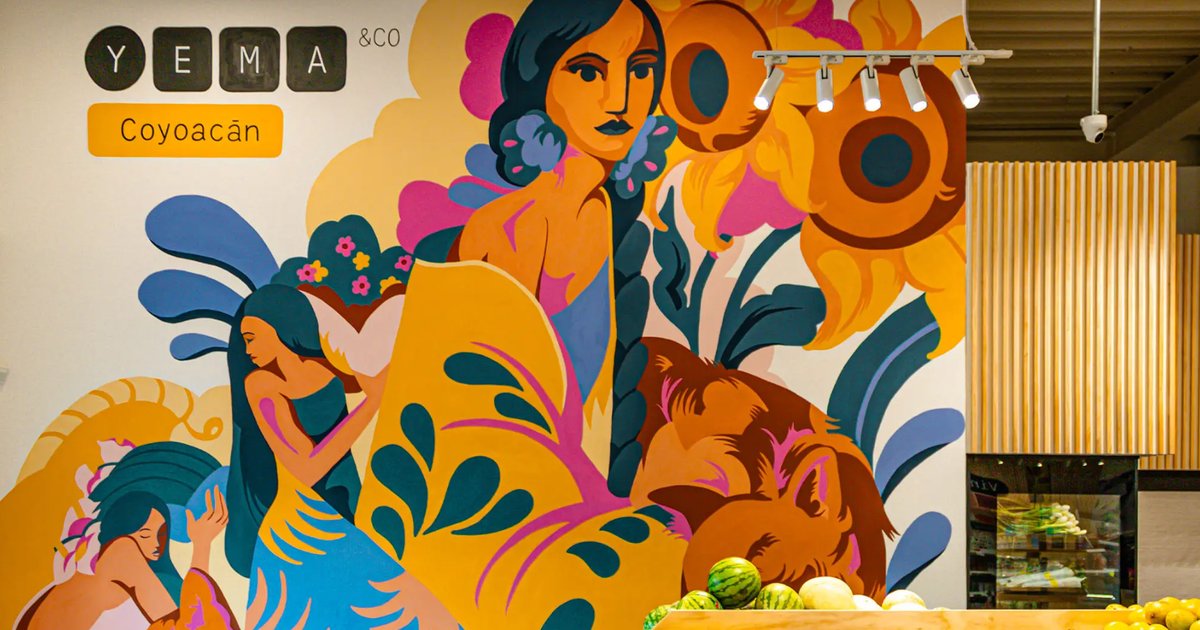
Cielo Abierto Coyoacan is a shopping plaza on Av. Miguel Angel de Quevedo, next to Oasis Coyoacan, that stands out for integrating murals and street art as a central part of its identity. Inside operates YEMA Coyoacan, a supermarket that has applied this same approach to its store design. Last week, the Muralia team visited both spaces to document how art can function as a tool for differentiation, retention and marketing in contemporary retail.
There are conventional shopping centers. And then there is Cielo Abierto Coyoacan.
Located on Av. Miguel Angel de Quevedo, next to Oasis Coyoacan, the plaza uses street art to accompany visitors throughout their entire experience.
When we first walked in, what caught our attention was not the storefronts. It was the murals. Large-format pieces at every corner. Graffiti that tells stories. Interventions that invite you to stop, photograph and share.
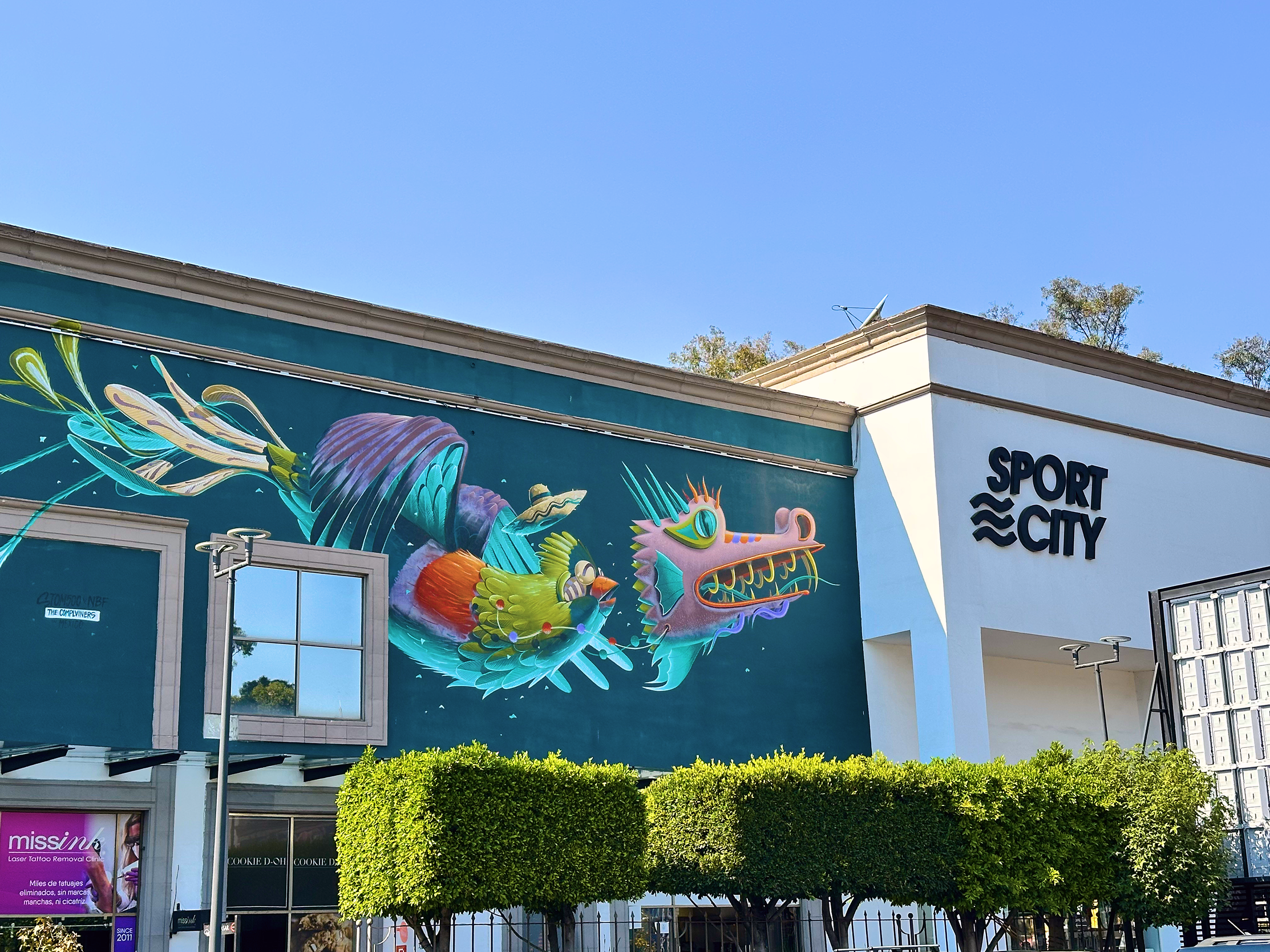
An imposing alebrije-style dragon, the work of artist Stom500, dominates the Sport City facade, integrating seamlessly with the surrounding vegetation.
Context: Art as an Identity System
Cielo Abierto integrates street art as a central part of the visitor experience, almost like an open-air gallery. This is not art as isolated decoration; it is a place identity system. Every mural, every graphic intervention contributes to a coherent experience that differentiates the plaza from any conventional shopping center.
Cielo Abierto: When a Mall Becomes a Gallery
The first thing you notice when walking through Cielo Abierto is that the experience does not revolve around the stores. The visual hook is not a clothing brand's window display or a restaurant's menu; it is the street art that accompanies you throughout your entire visit.
A perfect example of how murals democratize attention: on one of the main facades, we saw a series of four retail units topped by floral murals created by Reko Rises.
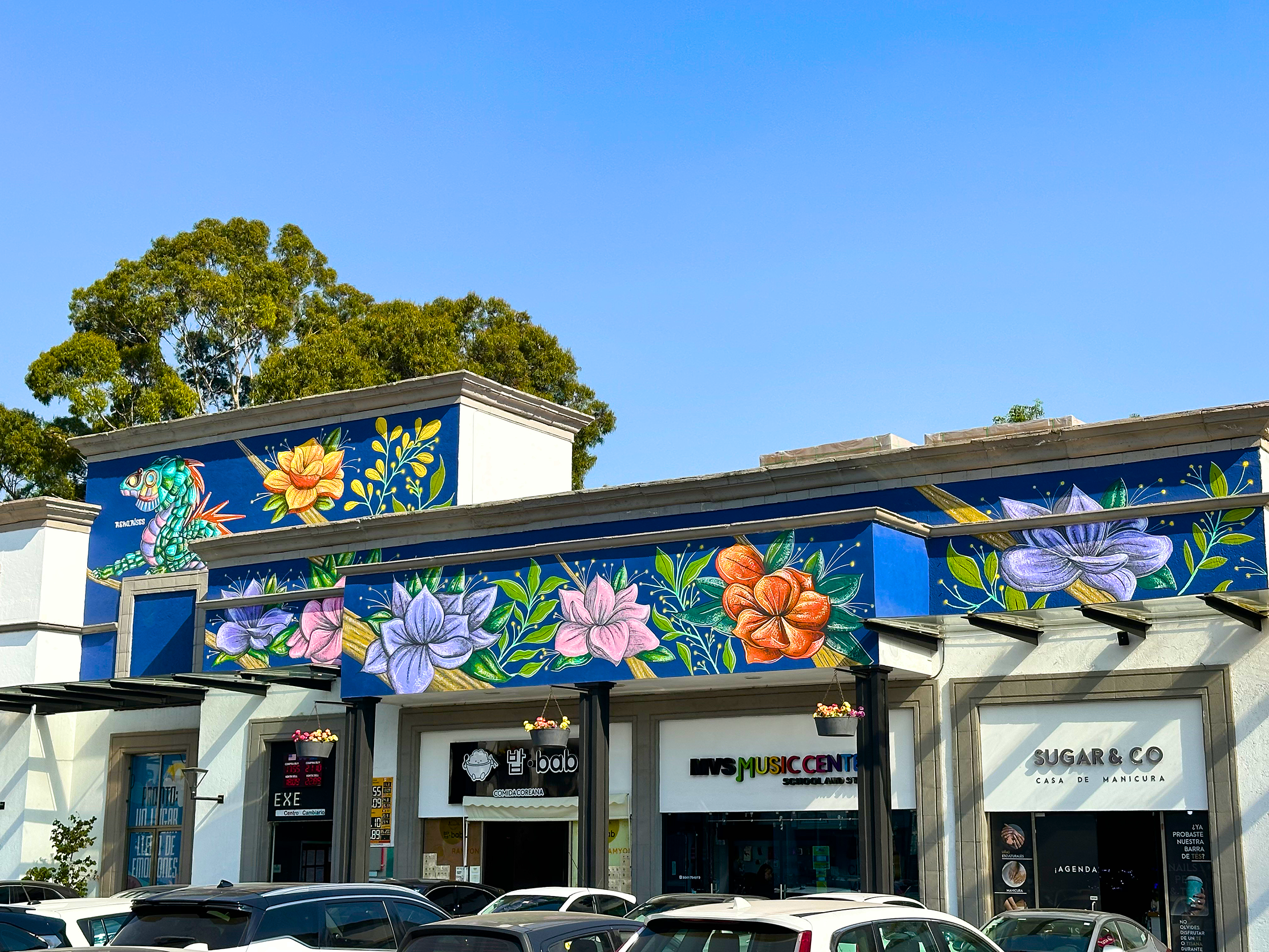
The floral murals do more than decorate - they visually unify large brands and small businesses, creating a shared identity.
This design decision produces visible results: the floral murals draw the eye upward and to the sides, distributing visual flow to both anchor stores and smaller businesses. Art acts as an equalizer, adding variety to what would otherwise be a monotonous row of storefronts.
The 3 Functions of Art in Commercial Spaces
After walking through the plaza and analyzing visitor behavior, we identified three critical functions that art performs here.
1. Emotional Wayfinding
You do not need a map to know where you are. Art creates an immediate and unique sense of place. Each zone has its own visual identity, making the space memorable.
2. Visit Retention
Art works as a reason to stay longer. Industry studies (ICSC, 2007) suggest that even a 1% increase in dwell time can be associated with approximately 1.3% more in sales.
3. Organic Marketing
Every mural is a natural backdrop for photos. Visitors become content creators by sharing their experience. It is authentic word-of-mouth generated by the customers themselves.
Direct Interaction: The "Umbrella Moment"
Speaking of organic marketing, we found a piece that takes this to the next level. On a tall facade spanning floor to ceiling, a mural depicts a fantastical dragon-serpent that seems to "pour" colors from above.
But the remarkable element is not just the dragon - it is what happens at street level: Reko Rises painted an umbrella at exactly the height of a person.
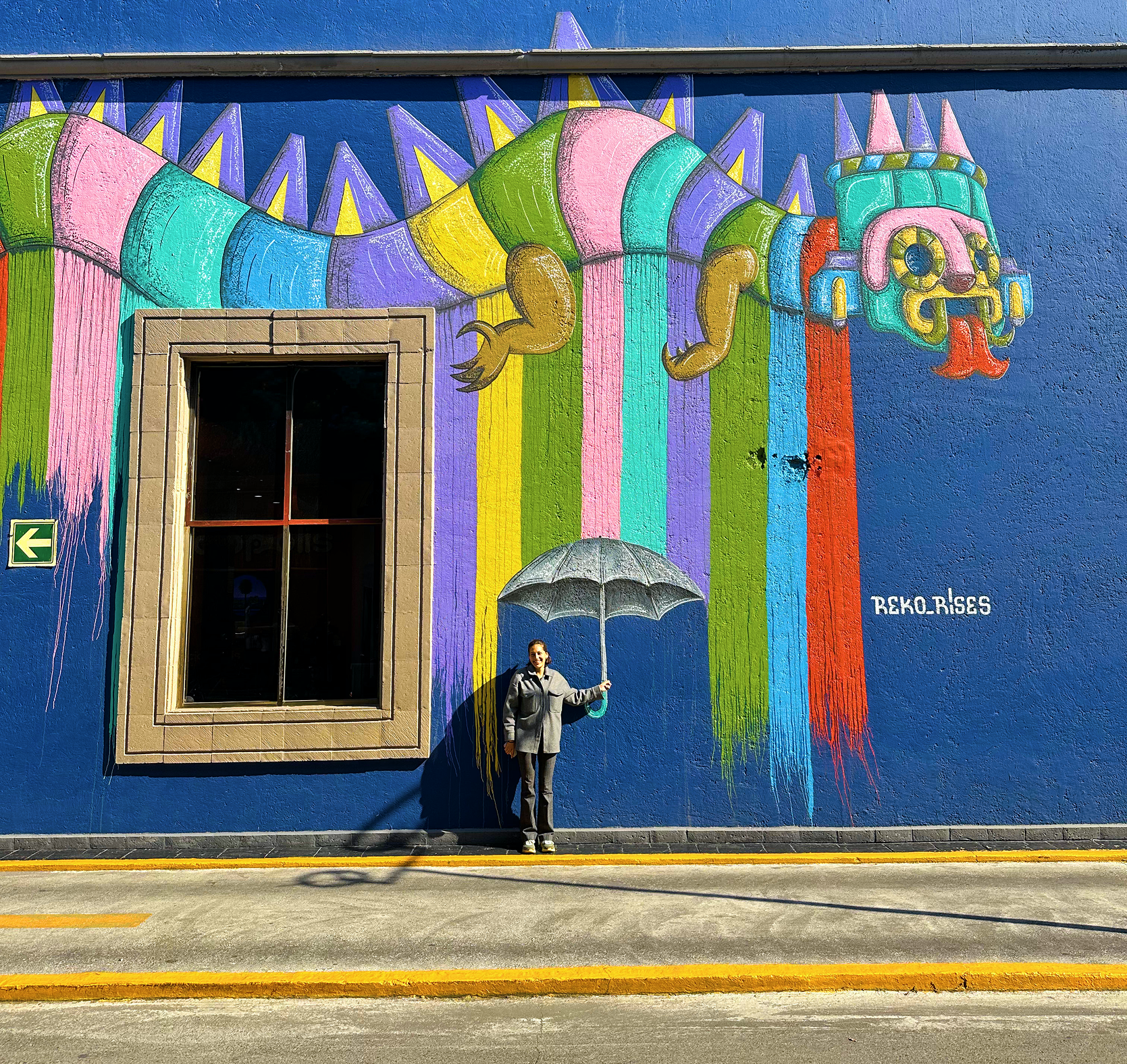
The mural invites interaction: visitors "hold" the umbrella to shield themselves from the rain of colors.
We saw people standing under the umbrella, pretending to hold the handle, sheltering from the rain of color. This simple element turns a passive wall into an active stage. You are no longer just looking at the art; you enter it. The design actively encourages visitor participation.
Diversity of Styles: From Mice to Roots
Cielo Abierto's curation understands that variety sustains interest. Near the ATM area, we encountered a striking graffiti piece depicting an alebrije in the shape of a large-eared mouse, another work by Stom500. The colors are so vibrant that they illuminate an area that would otherwise be purely functional and dull.
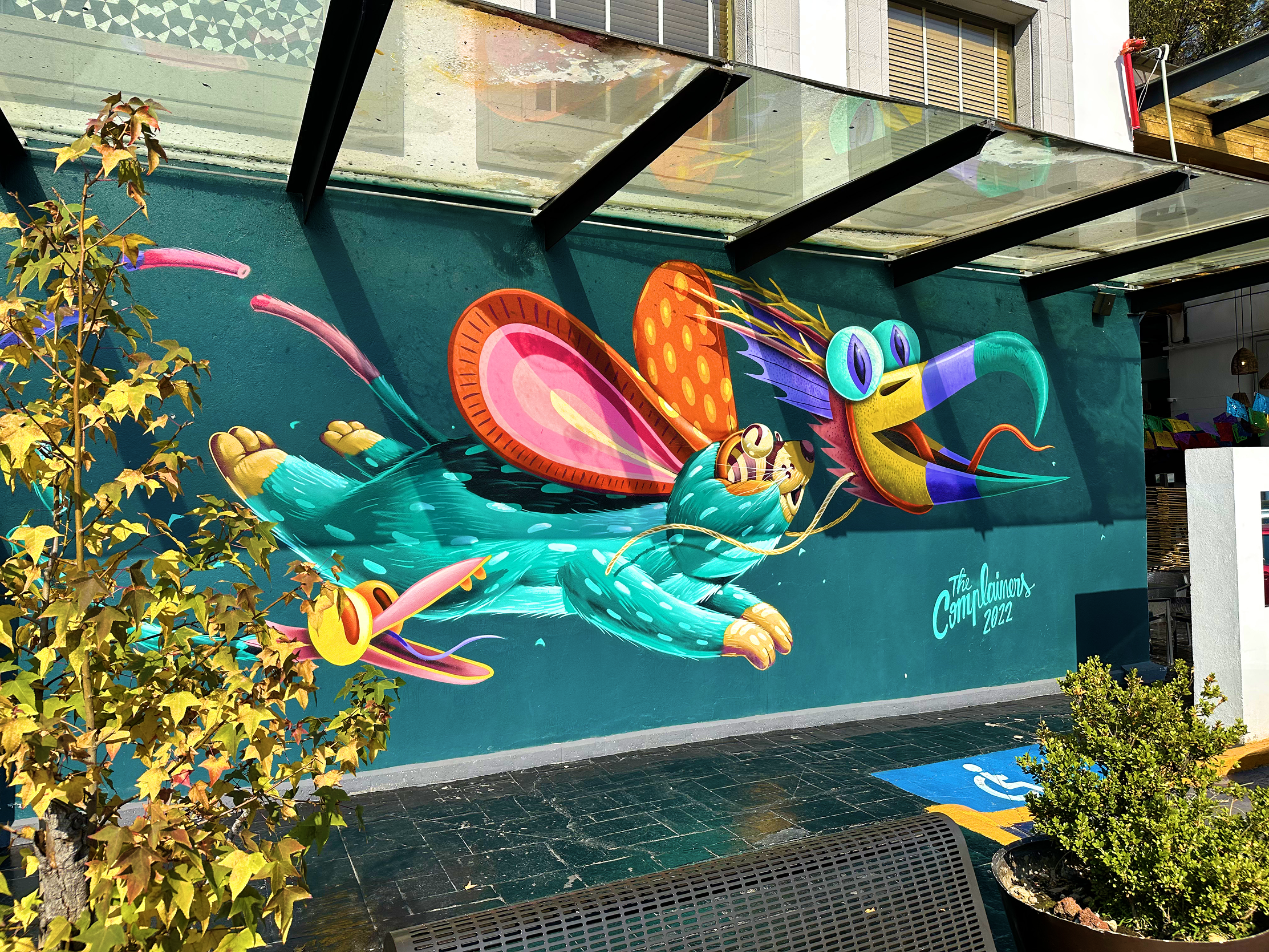
A must-see spot: The alebrije mouse brings the services area to life.
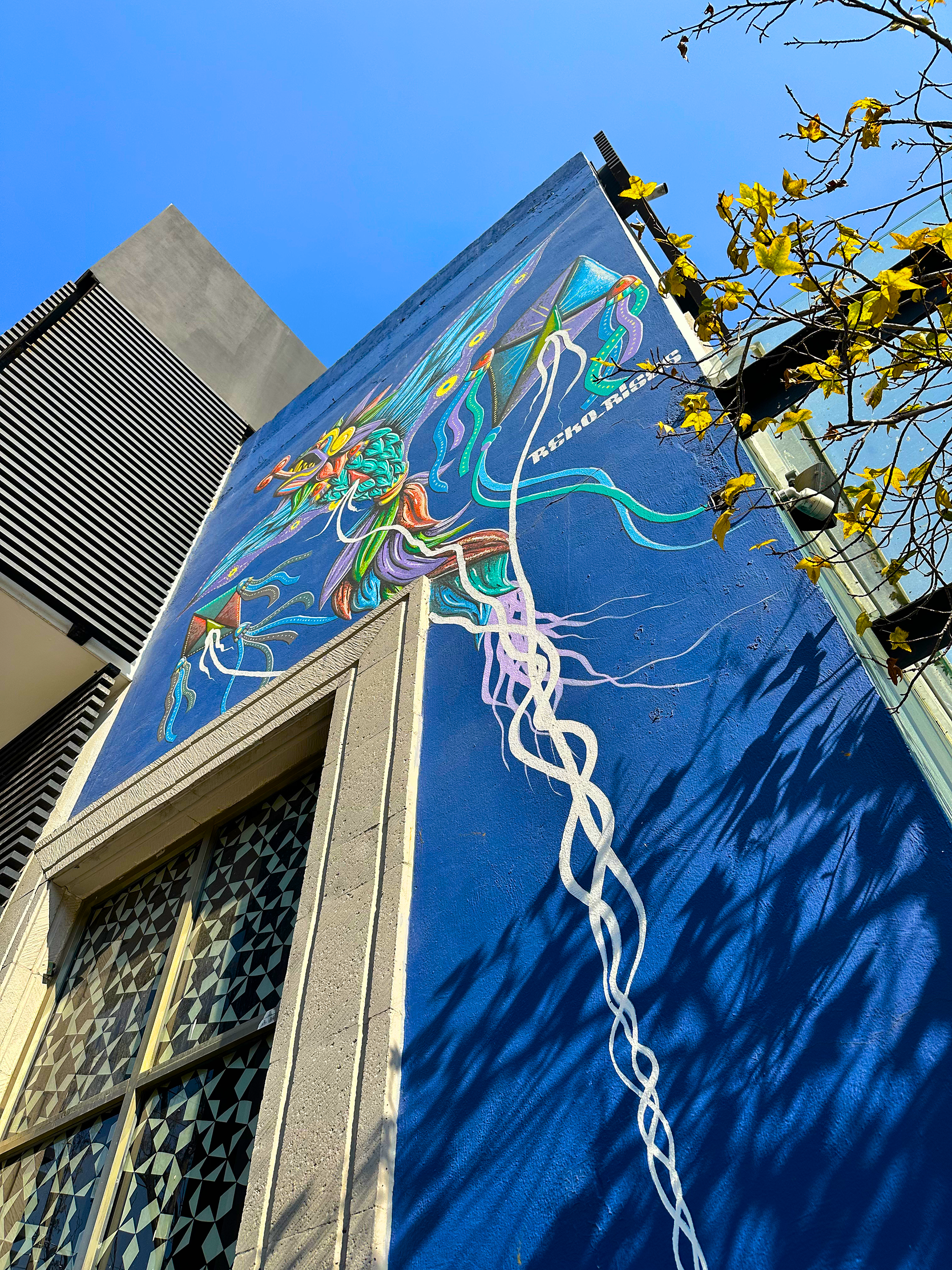
Natural integration: A roots mural that dialogues with the real trees.
By contrast, another tall and narrow facade displays colorful roots emerging from a tree, again by Reko Rises. What is interesting here is how the mural dialogues with its surroundings: the painted roots appear to extend toward the real trees in the plaza, blurring the line between architecture, nature and art.
YEMA in 60 Seconds
Before diving into the space analysis, it helps to understand what YEMA is and why their case is relevant.
- Founded: YEMA was founded in 2019 by Rene, Angie and Laurene.
- Philosophy: Honest ingredients, clear labeling and conscious consumption. Their value proposition focuses on offering quality products with transparency about their origin and composition.
- Own stores: They currently operate two locations: Escandon and Coyoacan.
- Distribution: They also distribute products through Tiendas 3B in CDMX and the State of Mexico.
The YEMA Coyoacan Case: Art Integrated into Retail
Inside Cielo Abierto operates YEMA Coyoacan, a supermarket that stands out for integrating street art into its interior design in a way that is coherent with its brand identity.
From outside, you can already tell this is not a conventional grocery store. And when you walk in, the visual experience reinforces that impression.
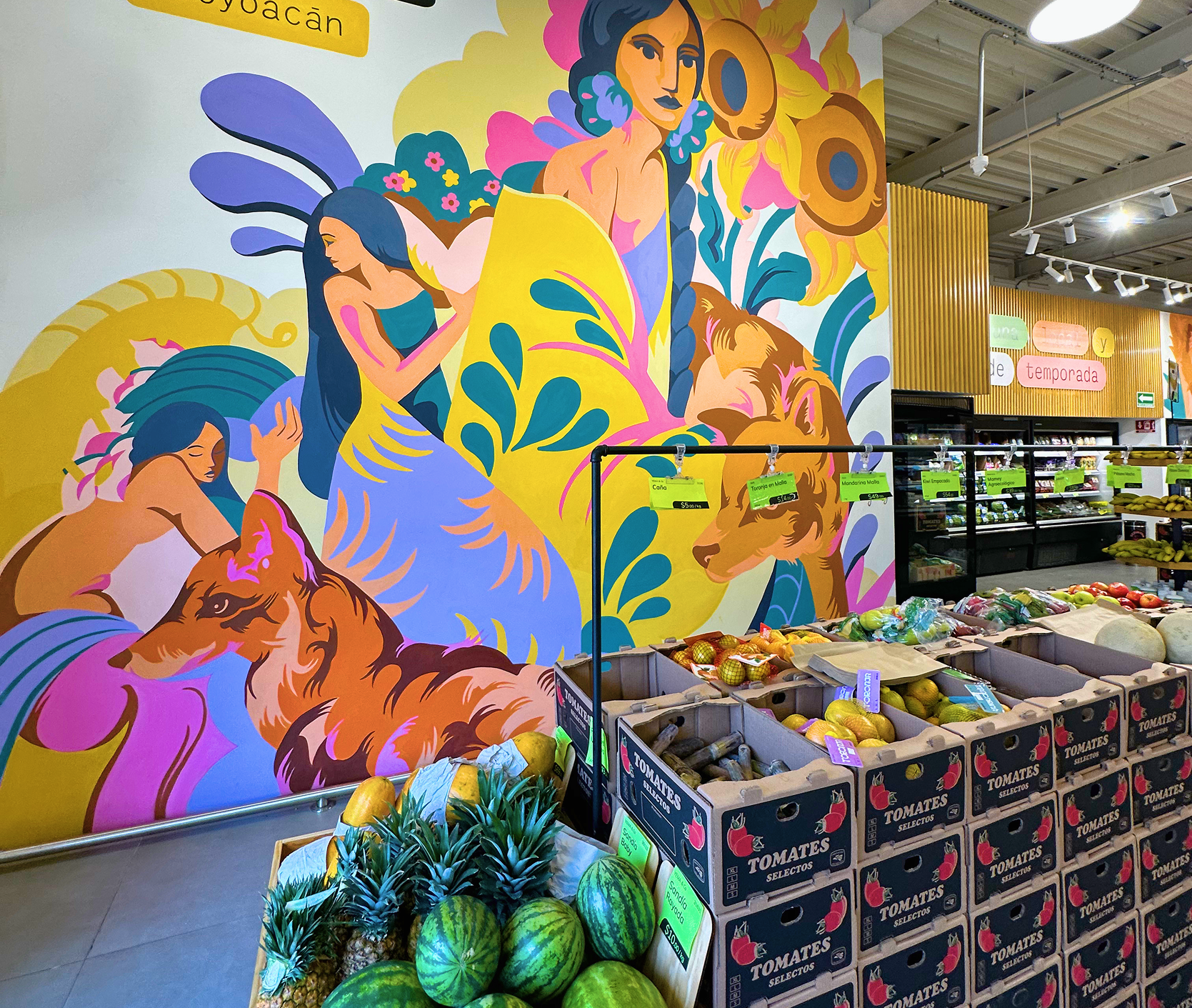
"YEMA Coyoacan": The welcome mural featuring a colorful female figure sets the tone from the produce section.
At the entrance, right in the produce section, you are greeted by a large-format mural bearing the text "YEMA Coyoacan". A female figure, painted in a distinctive and colorful style, appears to watch over the watermelons and fresh fruit. The mural's tones - yellows, oranges, blues - are synchronized with the natural color of the products and the brand's identity.
Strategic Interior Design
YEMA integrates commercial interiors with the brand's graphic identity. They did not stop at the entrance. In the refrigerated goods section, where you would normally see only metal and cold lighting, they placed a horizontal mural strip along the upper portion.
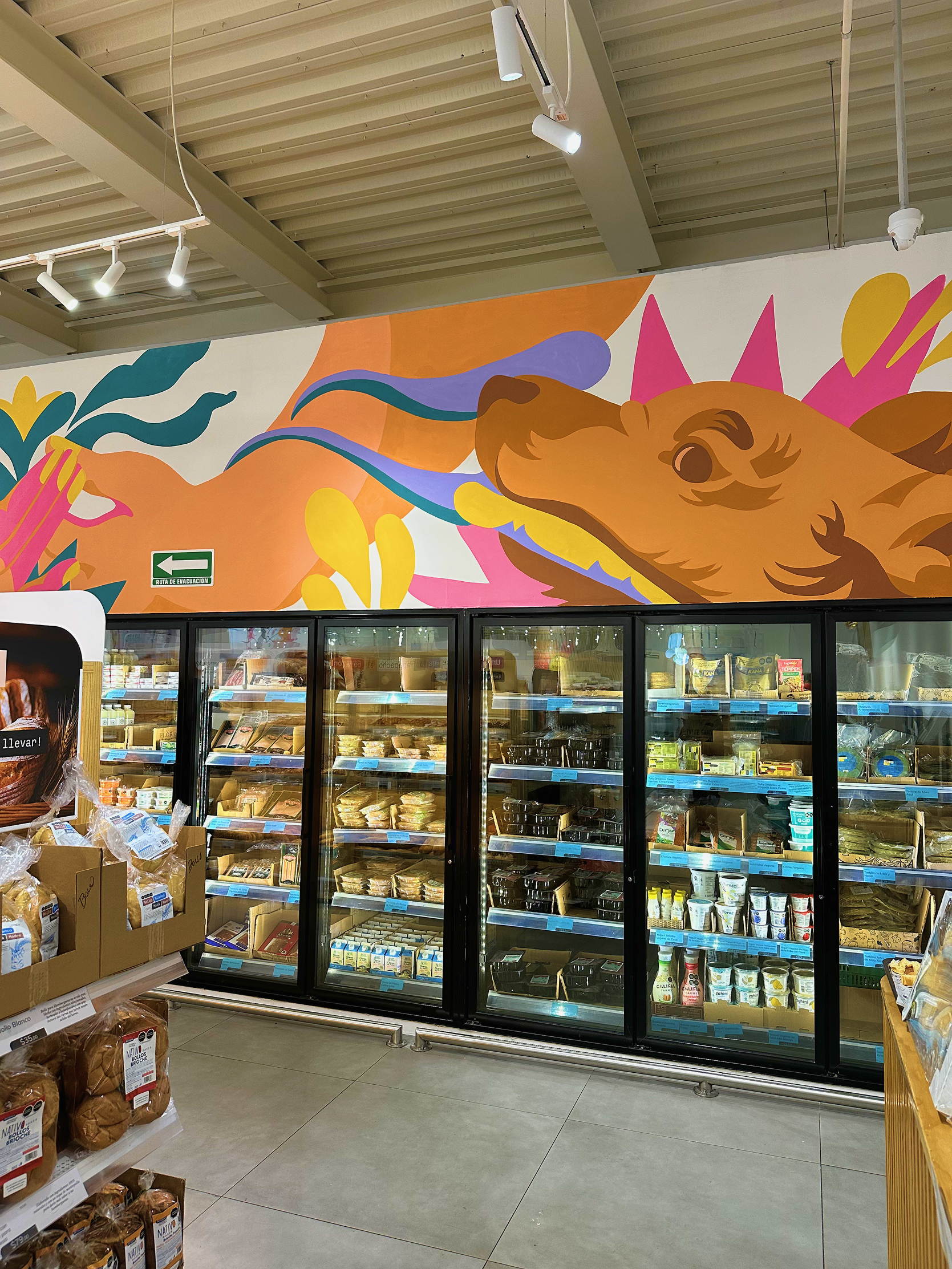
Vibrant contrast: The mural breaks the monotony of the white ceiling and refrigerators.
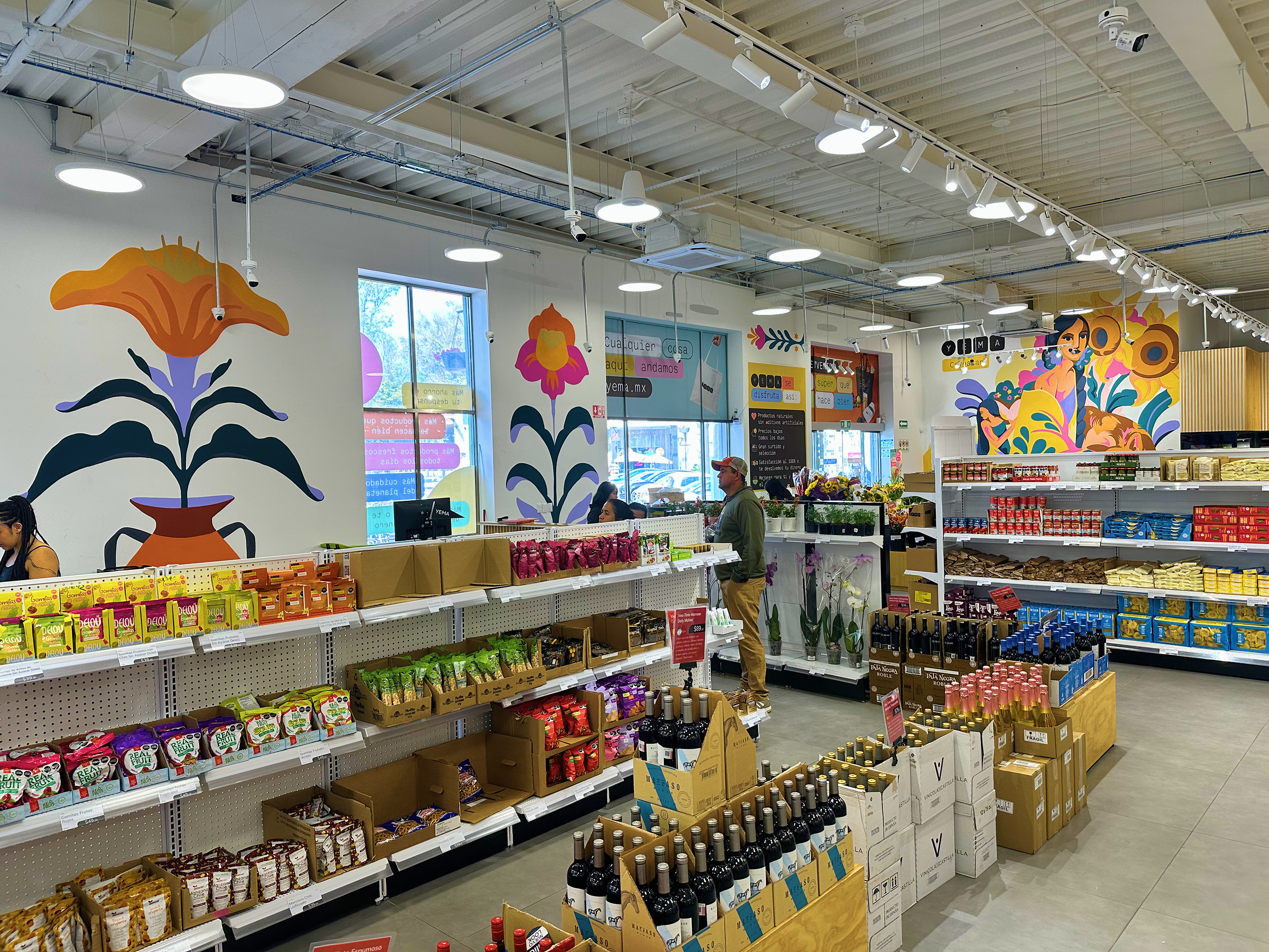
Details that matter: Each column at checkout has a unique flower in a pot.
This mural contrasts with the industrial white ceiling and echoes the colors of product packaging. It transforms a functional aisle into a space with greater visual warmth.
The final detail is at the checkout counters. The structural columns, which in any other supermarket would be gray or white, are canvases here. Each one has a different flower painted on it emerging from a pot against a clean white background. It is a touch of simple elegance that visually connects to the entrance mural and reinforces the feeling of freshness and nature right up to the last moment of the shopping experience.
The Maga Rey Mural: "A little piece of Coyoacan in your supermarket"
The main mural at YEMA Coyoacan was created by Maga Rey. On their official website, YEMA gives explicit credit to the artist, who explains the historical connection of her work:
"Coyoacan has a rich history dating back to pre-Hispanic times... The name comes from the Nahuatl word 'coyohuacan', meaning place of coyotes. The parks and gardens of the district are filled with a wide variety of flowers... and an essence full of vibrant colors; characteristics I seek to represent in my piece." - Maga Rey
This integration of local history and contemporary art is relevant to any retail operator or developer for several reasons:
Cultural Localization in Retail
Think about it: a supermarket, by definition, is an interchangeable space. You could be in any Walmart, Soriana or Chedraui in the country and the experience would be virtually identical. But by integrating a mural with local identity, YEMA makes the store feel like it belongs right here.
That sense of belonging reduces friction for neighbors to prefer it over a generic chain. You are not shopping at "a supermarket"; you are shopping at the Coyoacan supermarket.
It also creates memorability. A customer may not remember the aisles or exact prices, but they will surely remember "the supermarket with the beautiful mural." It is physical proof of the brand's promise: to sell experience and quality, not just price.
4 Actionable Lessons for Retail Operators
If you operate a commercial space, a store, a restaurant or are developing a real estate project, these are the lessons from our visit to Cielo Abierto and YEMA:
1. Art as a Brand System
Do not think of a mural as decoration - think of it as replicable brand infrastructure. It is as vital as your facade. If you operate multiple locations, a coherent visual language with local nuances reinforces your identity at every touchpoint.
2. Dwell Time Strategy
Turn the shopping trip into a stroll. Economic conversion increases when people enjoy your space. More dwell time translates directly into more sales opportunities.
3. Cultural Localization
Make your space belong to the neighborhood. Avoid being a generic brand and become a local neighbor through art. Communities respond with loyalty when they encounter authenticity.
4. Content Engine
An interactive mural is a perpetual marketing engine. The "umbrella moment" shows how a smart design triggers organic recommendations and user-generated content.
Bonus Lesson: Choose the Right Artist
Not every mural works for every space. YEMA chose a graphic style that aligns with their products and conscious consumption philosophy. The challenge is finding the artist whose visual language speaks the same language as your business.
The Challenge of Executing an Art Project in Retail
What Cielo Abierto and YEMA achieved is not simply a matter of painting. The real challenge lies in strategy: defining the brief, selecting the right artist, coordinating the operation, managing permits, establishing realistic timelines, planning maintenance and ensuring consistency across multiple locations.
Solving this consistently requires structure, not improvisation. Platforms like Muralia exist precisely to professionalize that process, connecting businesses with verified talent and managing execution from start to finish.