

Murals in Interior Design: What Every Architect Should Know
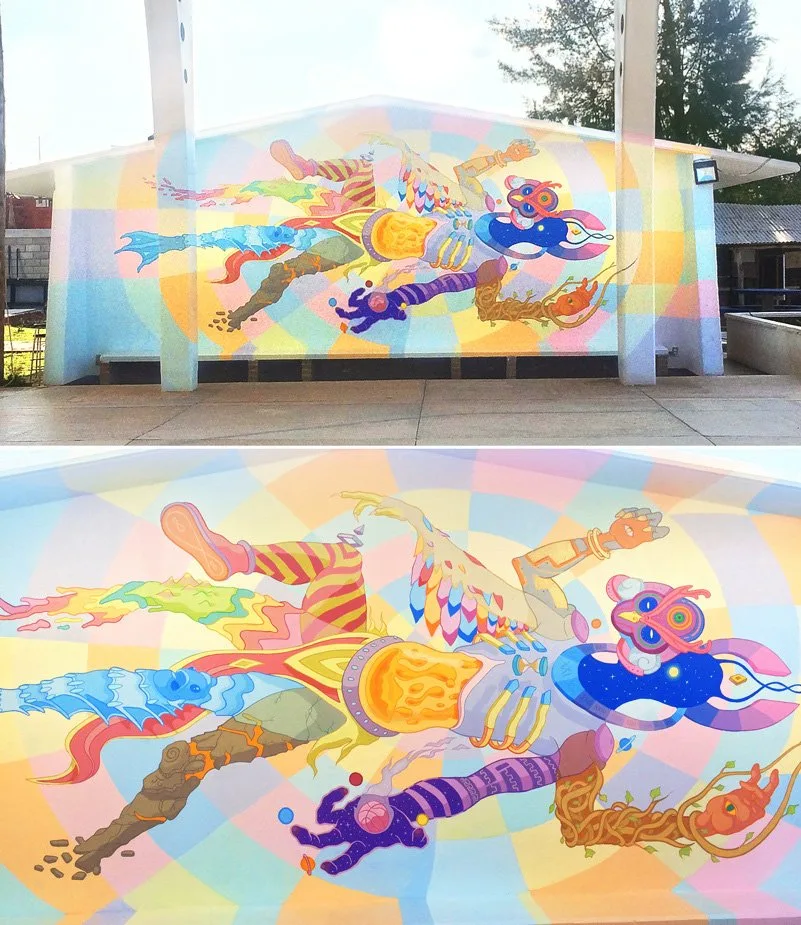
Murals have evolved from secondary decorative elements into a measurable interior design tool with proven impact on user experience, brand identity, and perceived space value. For architects and interior designers, integrating a mural into a project requires technical planning, contractor coordination, and contractual clarity. This article covers what you need to know to specify, budget, and execute murals within your architectural projects.
Contemporary muralism is not paint on an empty wall. It is an intervention that dialogues with architecture, responds to a design program, and needs to be integrated into the construction schedule. When executed well, a mural transforms a lobby, a facade, or a commercial space into a visual reference point. When improvised, it creates conflicts with contractors, delays, and results that do not align with the project vision.
The difference between both scenarios lies in the process. And that process begins long before the artist arrives on site.
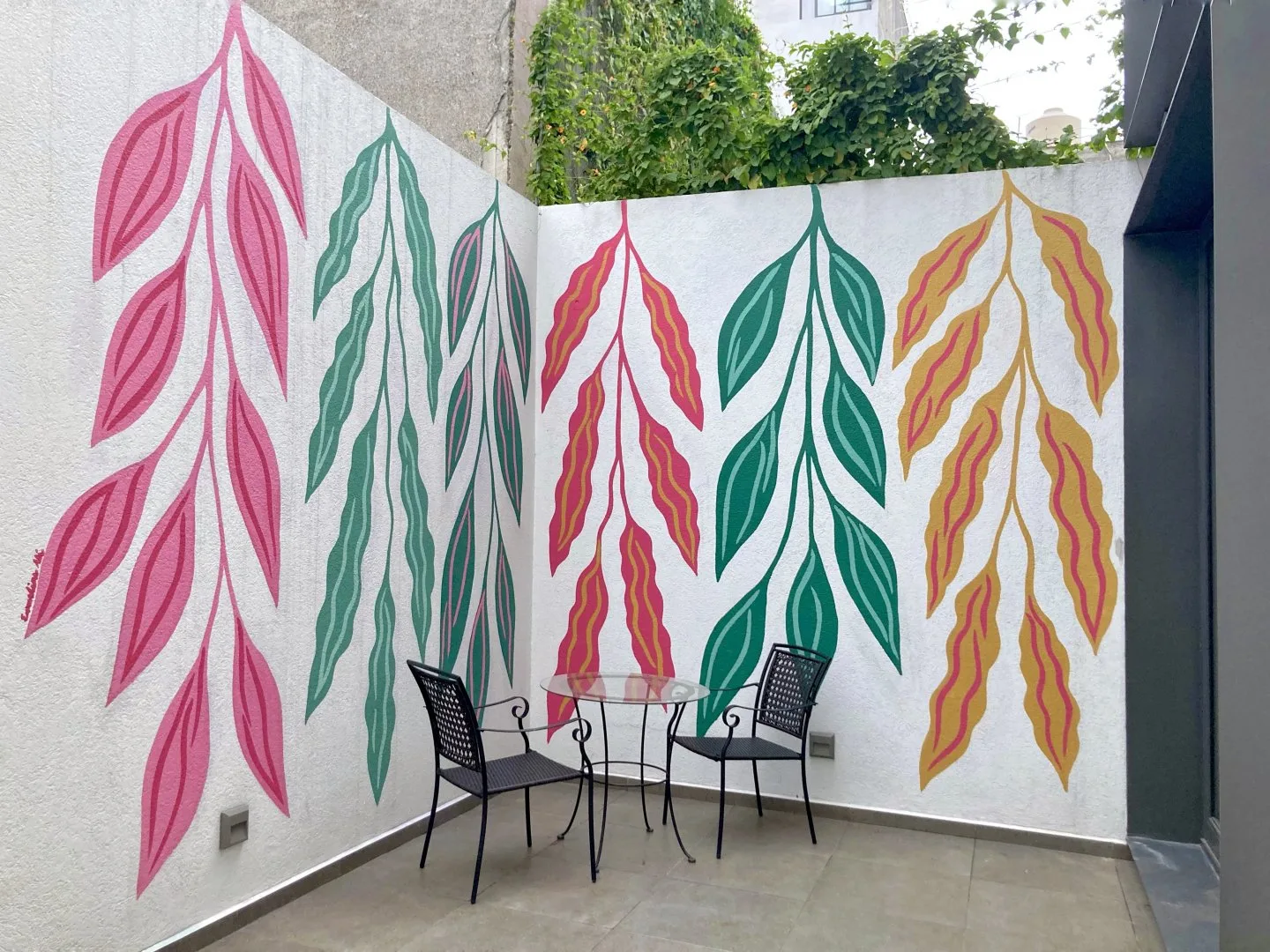
Integrating murals into architectural projects requires coordination from the early design phases to achieve results that are coherent with the space.
How to Specify a Mural in Architectural Drawings
A mural should appear in project documentation like any other finish. Omitting it from drawings creates ambiguity during construction and complicates coordination between trades. Below are the minimum elements a drawing set should include when the project includes a mural.
Finish Plans
Indicate the mural location with a dedicated hatch or finish code (e.g., “MUR-01”). Include exact dimensions of the designated area, clear height, and note whether the wall has concealed installations (ducts, access panels, wiring) that limit the available surface.
Sections and Details
A section through the mural wall should show the substrate (drywall, concrete, masonry), preparation layers, and final finish. This is relevant when the wall requires pre-treatment or when there are construction joints the artist needs to account for.
Dedicated Lighting
The electrical plan should include fixtures that highlight the mural without creating glare. Wall washers or adjustable track spots are the most common solutions. Defining this before electrical rough-in avoids exposed conduits or improvised lighting later.
Written Specifications
In the specification book, include a division for the mural with: required substrate type, preparation finish (smooth, sealed, primed), paint type (acrylic, latex, aerosol), final sealant (UV varnish, anti-graffiti), and site access conditions for the artist.
Surface Preparation Requirements by Substrate Type
Not all surfaces are created equal. The substrate determines the type of preparation needed, compatible materials, and mural durability. A common mistake is assuming that any wall “ready for paint” is ready for a mural. The reality is more technical.
- 1Exposed concrete: Requires pore sealing with epoxy or acrylic primer. If there is efflorescence (white salt deposits), it must be removed with diluted muriatic acid and allowed to dry for at least 72 hours before primer application. The natural texture of concrete can be an aesthetic resource, but the artist must know about it in advance to adapt their technique.
- 2Drywall (gypsum board): The most uniform and mural-friendly surface for interiors. Requires at least two coats of joint compound, fine sanding (150-220 grit), and a latex primer base coat. Panel joints must be perfectly flush - any irregularity will be visible under the mural paint.
- 3Plaster or stucco: Common in traditional construction. Requires crack repair, sealer application, and at least one coat of base paint in white or the color requested by the artist. Residual moisture from fresh plaster is the biggest risk: the wall should have at least 28 days of curing time before receiving artistic paint.
- 4Exposed brick: The irregular texture of brick is desirable in certain styles (street art murals or organic interventions) but makes detailed work difficult. If a smooth surface is required over brick, a plaster skim coat is necessary. If painting directly on brick, a high-penetration sealer is needed to prevent excessive absorption.
- 5Metal or composite panels: Common in contemporary facades and industrial spaces. Require anticorrosive primer and specialized paint. Adhesion is the critical factor - adhesion tests before executing the mural are recommended for these substrates.
““Surface preparation accounts for 20% to 30% of a mural's total cost. Skipping it does not save money - it transfers the cost to future repairs.”
When to Integrate the Mural: Design Phase vs. Post-Construction
The decision of when to incorporate a mural into the project has direct implications on cost, quality of results, and coordination complexity. There are two valid approaches, each with distinct advantages and limitations.
Design Phase Integration
The mural is considered from the schematic design stage. The artist participates in design reviews, the wall is prepared according to artistic specifications, and lighting is designed to complement the piece.
- Optimized surface preparation
- Lighting integrated into the electrical plan
- Coordination with other finishes
- Lower risk of rework
Post-Construction
The mural is executed on an already completed space. This works when the client decides to incorporate art after handover, or when the space is being adapted for a new use. It requires protecting existing finishes during execution.
- Flexibility in content decisions
- Independent from construction schedule
- Adaptable to tenant changes
- Cost separate from construction budget
The general recommendation for new projects is to integrate the mural from the design phase. This allows coordinating substrate preparation with the general contractor, avoiding conflicts with concealed installations, and designing appropriate lighting. According to data from the American Institute of Architects (AIA), design changes during construction cost between 5x and 10x more than changes made during the planning phase.
Coordinating with General Contractors and Paint Subcontractors
One of the most common friction points in projects that include murals is coordination between the artist, the general contractor (GC), and paint subcontractors. The mural occupies space that other trades need, and its execution requires specific conditions.
Recommended Coordination Protocol
- 1Pre-construction: Inform the GC that the project includes a mural. Share the exact location on drawings and surface preparation requirements. The GC should include wall preparation in their scope or coordinate with a specialized subcontractor.
- 2During construction: The wall designated for the mural should not receive final paint from the paint subcontractor. Only primer and sealer per the artist's specifications. Clearly mark on site which walls are “mural zones” to prevent accidental painting.
- 3Execution window: Schedule mural execution after wet trades (plaster, flooring) are complete and before fixed furniture or delicate nearby finishes are installed. The ideal window is 2 to 3 weeks before final handover.
- 4Site conditions: The artist needs access to electricity, water, ventilation (especially for indoor aerosol work), and space for equipment (scaffolding, ladders, projector). These requirements should be communicated to the GC at least two weeks in advance.
- 5Post-execution protection: Once the mural is complete, coordinate with the GC to protect the piece during final construction activities. Polyethylene sheeting secured with low-tack tape is the standard method. The final sealant (UV varnish or anti-graffiti coating) is applied 48-72 hours after the paint is finished.
Intellectual Property and Artist Rights
Murals occupy a particular position in copyright law. In many countries, the artist retains moral rights over the work even when it was commissioned and paid for in full. This has practical implications that architects should consider.
In the United States: VARA
The Visual Artists Rights Act (VARA) of 1990 protects the integrity of visual artworks, including murals. Under VARA, a property owner cannot destroy or substantially modify a mural of “recognized stature” without notifying the artist 90 days in advance. In practice, this means that demolishing or covering a mural can create legal liability if proper procedures are not followed.
In Mexico and Latin America
Mexico's Federal Copyright Law recognizes inalienable and non-waivable moral rights. The artist retains the right of attribution (to be recognized as author) and the right of integrity (to oppose modifications that affect their reputation). Similar legislation exists in Colombia, Argentina, and Chile, with variations in scope.
Practical recommendations for architects are clear:
- Include a patrimonial rights assignment clause in the artist contract, specifying permitted uses (reproduction in project publications, photography, marketing).
- Document the finished work with professional photography before handing the space over to the end client.
- Agree in writing on the conditions under which the mural may be removed or modified, especially in projects with lease agreements.
- When the project is for a third party, transfer these contractual obligations to the final property owner.
The Mural as a Line Item in the Construction Budget
One of the most frequent mistakes is treating the mural as a discretionary expense to be decided “if budget remains.” When the mural is part of the design concept, it should have its own budget line item from the project's inception.
Typical Mural Cost Structure
- ADesign and sketch: 10-15% of total. Includes conceptualization, digital render, and revisions. Some artists charge for this phase separately.
- BSurface preparation: 20-30%. May fall within the GC's scope or the artist's, depending on the contractual agreement. Defining this clearly avoids duplications or gaps.
- CMaterials: 15-20%. Professional-grade paint, primers, sealers, protective varnish. Professional-quality materials can double the cost compared to standard commercial paint.
- DArtistic labor: 35-45%. The primary cost component. Varies based on the artist's experience, design complexity, and mural dimensions.
- EEquipment and logistics: 5-10%. Scaffolding, lifts, protection of adjacent areas, artist travel if coming from another city or country.
- FSealing and final protection: 3-5%. UV varnish, anti-graffiti coating, or clear sealant. Essential for durability, especially for exterior murals.
As an industry reference, a medium-complexity interior mural in a commercial project can range from USD $30 to $120 per square foot (USD $320-$1,290/sqm), depending on the market, the artist, and the complexity. In Latin America, ranges are generally more competitive, with costs between USD $15 and $70 per square foot for comparable projects.
For architecture firms, the recommended approach is to request quotes during the design development phase, when dimensions and specifications are defined. This allows including the mural as a formal line item with a fixed price, avoiding surprises during construction.
How Platforms Simplify Artist Sourcing
Traditionally, finding the right muralist for an architectural project meant relying on personal contacts, social media searches, or referrals from other professionals. This informal process creates inefficiencies: long search times, difficulty comparing portfolios, lack of verifiable references, and unstructured negotiations.
Specialized platforms like Muralia are transforming this process. With a network of over 250 verified artists across more than 60 cities and 4 countries, the platform enables architects and designers to find talent that matches the style, budget, and location requirements of their project.
AI-Powered Matchmaking
The system analyzes the project brief - style, dimensions, budget, location - and recommends artists whose portfolio aligns with the requirements. This reduces search time from weeks to minutes.
Structured Quotes
Instead of informal negotiations, artists submit quotes with cost breakdowns, timelines, and technical specifications. Architects can compare proposals in a standardized format, streamlining decision-making.
Verified Portfolios
Every artist on the platform has a verified portfolio with photos of real projects. This eliminates the uncertainty of working with an artist whose work you have only seen on Instagram, where filters and angles can be misleading.
For an architecture firm managing multiple simultaneous projects, this type of platform offers a concrete operational advantage: it centralizes the management of artistic vendors, maintains a collaboration history, and reduces dependence on a single contact network. In a market where the best artists have packed schedules, having access to a diverse and global network can be the difference between meeting a deadline and delaying a handover.
Architect's Checklist: Before Including a Mural in Your Project
- Define the mural location on finish plans with exact dimensions and a finish code.
- Identify the substrate type and specify the required preparation.
- Verify there are no concealed installations (ducts, wiring, access panels) on the designated wall.
- Design dedicated lighting for the mural in the electrical plan.
- Include the mural as an independent budget line item with a fixed price.
- Inform the general contractor about the mural and its access requirements.
- Schedule the execution window: after wet trades, before fixed furniture.
- Establish intellectual property agreements and modification/removal conditions in writing.
- Request quotes through specialized platforms to compare options in a structured way.
- Document the finished mural with professional photography before handing over the space.
For Architecture and Interior Design Firms
If you are developing a project that involves mural integration, Muralia can help you find the right artist. With over 250 verified muralists across 4 countries, structured quotes, and an AI-based matchmaking system, the platform is designed for professionals who need predictable results and clear processes.
You can explore the artist catalog, post your project for free, and receive proposals at muralia.art.