

What is Abstract Art in Murals? From Kandinsky to Your Wall
Abstract art in murals translates emotions, rhythms, and concepts to large scale without relying on recognizable figures. From Kandinsky's earliest canvases to the walls of hotels, corporate offices, and cultural centers today, abstraction has proven to be one of the most versatile visual languages for transforming architectural spaces. In this article, we explore its history, its subtypes, and how you can incorporate it into your next mural project.
A Brief History of Abstract Art
Abstraction did not appear out of nowhere. In the early twentieth century, artists such as Wassily Kandinsky, Piet Mondrian, and Kazimir Malevich began exploring the idea that color, form, and line could communicate on their own, without the need to represent the visible world. Kandinsky, often considered the pioneer of abstract painting, published Concerning the Spiritual in Art in 1911, a manifesto arguing that color and composition could evoke profound emotional states.
Over the following decades, the movement branched out. Mondrian reduced painting to straight lines and primary colors through his neoplasticism. In the 1940s and 1950s, American abstract expressionism, led by Jackson Pollock, Mark Rothko, and Willem de Kooning, introduced gesture, dripping, and color fields as forms of direct expression. In parallel, artists like Hilma af Klint in Sweden and Saloua Raouda Choucair in Lebanon had explored abstraction from distinct cultural traditions, expanding its reach beyond the Western canon.
Today, abstraction is not a style of the past. It is a living language that artists in cities like São Paulo, Tokyo, Mexico City, Lagos, and Berlin apply daily to large-format surfaces, adapting it to contemporary architectural, cultural, and commercial contexts.
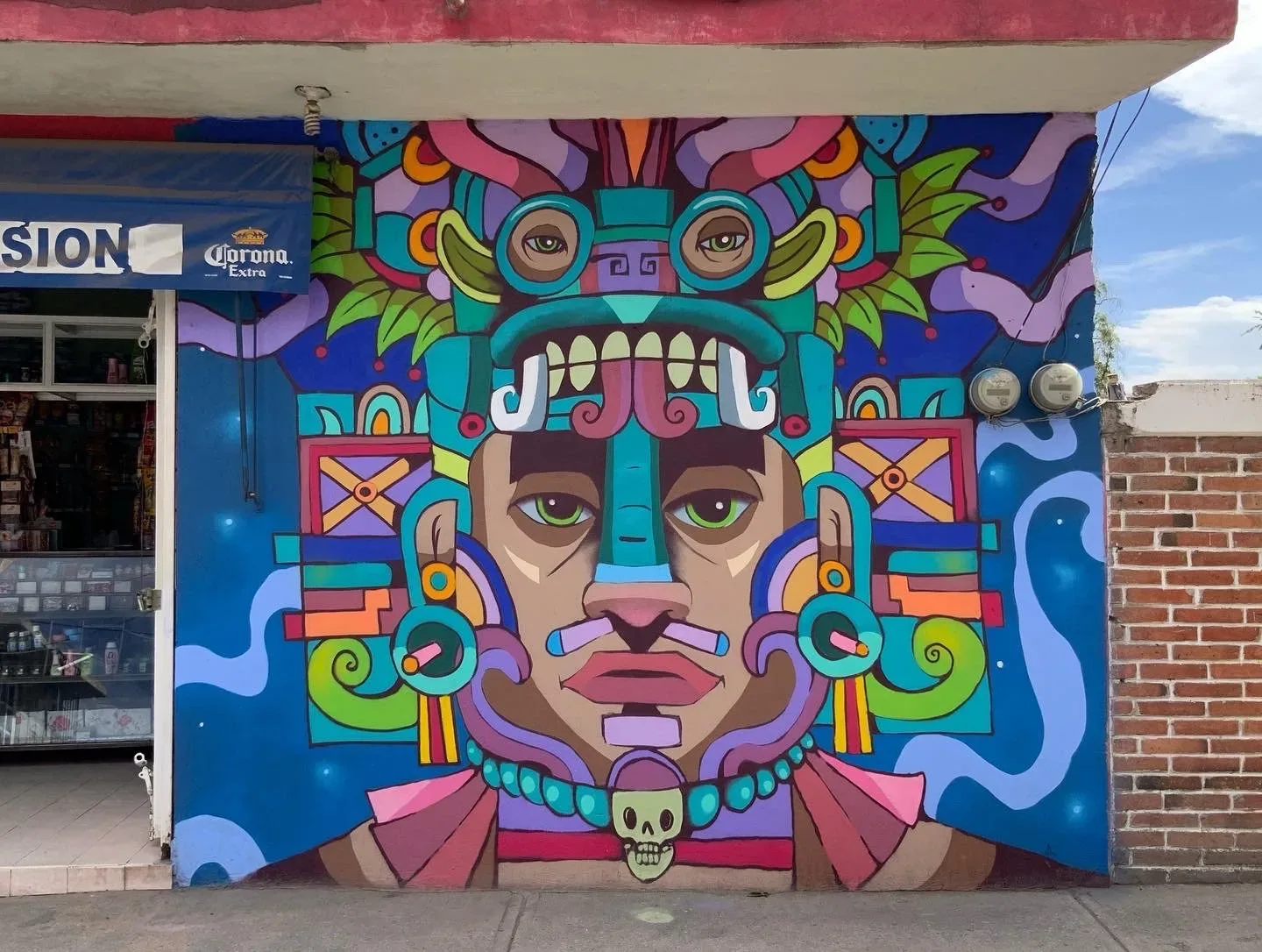
Large-scale abstraction transforms the perception of architectural space, generating visual rhythm and depth where there was once a neutral wall.
From Gallery to Wall: Why Abstraction Works at Scale
There is a substantial difference between a 60 cm abstract painting and a 15-meter abstract mural. Scale does not merely amplify the image; it transforms the viewer's relationship with the work. An abstract mural envelops. It is not observed from a fixed point but experienced in motion, as the visitor walks, turns, or steps back.
This characteristic makes abstraction a natural ally of architecture. While a figurative mural competes with the built environment (windows, columns, signage), an abstract mural can integrate with it. Geometric forms can follow structural lines. Color fields can soften transitions between materials. Organic patterns can humanize industrial surfaces.
In practice, many architects and interior designers prefer abstraction precisely because it allows them to control the atmosphere of a space without imposing a specific narrative. The mural does not tell a literal story; it creates a mood.
The Four Subtypes of Abstract Murals
Not all abstraction is the same. Within the mural world, we can identify at least four main approaches, each with distinct technical characteristics and applications.
1. Geometric Abstraction
Straight lines, defined angles, repetitive patterns. An heir to Mondrian and the Bauhaus, this approach works with mathematical precision and controlled palettes.
Best for: corporate offices, lobbies, commercial facades. Projects order, modernity, and sophistication.
2. Organic Abstraction
Curved, fluid forms inspired by nature without representing it literally. Evokes landscapes, water, plant growth, or geological formations through free gesture.
Best for: spas, restaurants, wellness spaces, residences. Conveys calm, movement, and connection with the natural world.
3. Color Field
Large areas of uniform color or gradual transitions. Inspired by Rothko and Helen Frankenthaler, it prioritizes chromatic experience over form.
Best for: hotels, galleries, meditation spaces. Creates emotional immersion and contemplative environments.
4. Abstract Expressionism
Gestural, energetic, with splashes, broad strokes, and visible textures. An heir to Pollock and de Kooning, it prioritizes the physical action of the artist as part of the work.
Best for: bars, creative studios, cultural spaces. Communicates energy, authenticity, and avant-garde spirit.
When to Choose an Abstract Mural
Abstraction is not the universal answer for every project, but there are contexts where it proves particularly effective. Understanding when it works - and when it does not - is key to making a sound decision.
Corporate Spaces
In offices, abstraction avoids specific cultural associations, which is relevant for multinational companies with diverse teams. An abstract mural in a lobby conveys creativity without polarizing. Technology firms in Singapore, design agencies in Amsterdam, and consulting firms in Toronto have adopted this approach.
Modern Architecture
Buildings with clean lines, exposed concrete, and glass benefit from abstract murals that do not compete with a minimalist aesthetic. Geometric abstraction, in particular, integrates with the structure without generating visual noise, complementing facades in cities like Dubai, Melbourne, or Bogota.
Hospitality
Boutique hotels, chef-driven restaurants, and spas use abstraction to create memorable atmospheres without conditioning the guest's experience. A warm-toned color field can define the identity of a bar in Lisbon or a hotel in Tulum without resorting to literal local motifs.
“A good abstract mural does not decorate a space. It transforms it. It changes how people move, pause, and feel within it.
Color Theory in Abstract Murals
In abstraction, color is not secondary; it is the message. A well-executed abstract mural relies on color theory principles to generate the desired effect on the viewer.
- 1Warm palettes (reds, oranges, yellows): Generate energy, urgency, and dynamism. They work well in restaurants, gyms, and collaborative workspaces where activation is the goal.
- 2Cool palettes (blues, greens, violets): Evoke calm, focus, and depth. Common in clinics, executive offices, and meditation spaces.
- 3Monochromatic and neutral: Sophistication and versatility. A grayscale mural with accents of a single color can integrate into any interior design scheme without conflict.
- 4High contrast and complementary: Capture attention immediately. Useful on exterior facades, festivals, and spaces where the mural must compete with visual stimuli from the urban environment.
A professional muralist does not choose colors by isolated intuition; they consider the space's natural light, surrounding materials, the function of the venue, and the client's brand identity. In an abstract mural, where there are no figures to anchor attention, color becomes the backbone of the composition.
Abstraction Around the World: Notable Examples
Abstract muralism does not belong to any single region. Here are examples that illustrate its global reach:
- -Wynwood Walls, Miami: The district has hosted abstract pieces by artists such as Maya Hayuk, whose radiating line compositions in saturated colors cover entire facades and have made the area a global benchmark for urban art.
- -MURAL Festival, Montreal: Every year, this festival commissions large-format pieces including geometric and organic abstraction on the walls of Boulevard Saint-Laurent, integrating art with the neighborhood's daily life.
- -Kassel and Berlin, Germany: The German tradition of abstract art, from the Bauhaus to the present day, is reflected in geometric murals that dialogue with modern architecture rebuilt after the war.
- -São Paulo, Brazil: Artists like OSGEMEOS have fused abstraction with figurative elements in monumental-scale murals, while geometric muralists intervene on metro infrastructure and viaducts.
- -Dubai and Abu Dhabi, UAE: Rapid urban growth has generated demand for abstract art in skyscraper lobbies and public spaces, where abstraction avoids religious or cultural references that might prove sensitive in international contexts.
How to Brief an Abstract Mural Project
One of the most common challenges when commissioning an abstract mural is communication. When there is no concrete figure to describe, the brief can become vague. These guidelines help structure the conversation with the artist:
Guide to an Effective Brief
- 1Define the emotion, not the image. Instead of asking for “something abstract,” describe what you want people to feel: calm, energy, wonder, sophistication. This guides the artist with greater precision than a formal description.
- 2Share visual references. Gather 5 to 10 images of murals, artworks, or even nature photographs that capture the aesthetic direction you seek. References speak louder than words.
- 3Specify color constraints. If your brand has a defined palette, share it. If the space has dominant materials (wood, concrete, steel), the artist needs to know in order to create visual coherence.
- 4Indicate the preferred subtype. Geometric, organic, color field, or expressionist. If you are unsure, share the subtype cards from this article with the artist to align expectations.
- 5Document the space. Send photos of the wall with measurements, information about natural light (orientation, direct sunlight hours), and any physical obstacles (pipes, windows, outlets). In abstraction, composition depends on the actual space.
Find the Right Abstract Muralist
On Muralia, you can filter artists by style, including geometric, organic, and expressionist abstraction. Our platform connects clients anywhere in the world with verified muralists who master large-scale abstraction.
The process is straightforward: describe your project, define your budget, and receive proposals from artists whose portfolio aligns with what you are looking for. Each proposal includes sketches, a timeline, and a cost breakdown, enabling informed decision-making.
Whether it is a 5-meter interior wall in an office in Monterrey or a 30-meter facade on a hotel in Barcelona, abstraction has the potential to turn an ordinary surface into a visual landmark.